Rancho Mirage HOA and Country Club Costs: What Buyers Must Separate
Rancho Mirage Tommy Jordan August 17, 2026
Rancho Mirage Tommy Jordan August 17, 2026
Two Rancho Mirage homes can have similar purchase prices and completely different costs to own. One of the easiest mistakes is to look at a listing, see one monthly number, and treat every community expense as “the HOA.”
In a country club or gated community, the actual cost structure can be much more layered. There may be a base association assessment, a second association, a social-club charge, separate golf dues, an initiation or replenishment fee, a special assessment, usage charges, and sometimes a ground lease. Those obligations do not all pay for the same thing, and they do not always change at the same time.
If you are comparing properties, the goal is simple: separate every required, included, optional, one-time, and recurring charge before deciding which home fits your budget. For broader property-level issues, start with the Rancho Mirage home-buying guide.
Do not compare Rancho Mirage homes by HOA dues alone. Build a complete ownership-cost list for each property that separates association assessments, club or social membership, golf dues, initiation or replenishment fees, transfer or capital charges, special assessments, usage fees, and any ground-lease payment. Then confirm which charges are mandatory, which are included, which are optional, and what each one actually covers.
Fees and membership structures can change. For a specific property, use the current HOA disclosure package, current club membership materials, title and escrow documents, and the terms of the purchase contract.
Before deciding whether a fee is high or low, identify every layer attached to the property. Rancho Mirage includes non-HOA neighborhoods, gated communities, condominium-style associations, golf communities, and private clubs, so there is no single cost structure that applies citywide.
A useful first pass is to separate these categories:
The right comparison is not “Home A has a $700 HOA and Home B has a $1,500 HOA.” The right comparison is “What is every required dollar attached to each home, what does it pay for, and what can change after you buy?”
The Springs is a useful Rancho Mirage example because its current documents show several charges working together. Its official 2025–26 HOA information sheet lists a monthly homeowner assessment of $1,826, made up of a $1,340 base assessment, a $67 cable assessment, and a $419 social-club assessment. The same sheet lists a separate $15,000 HOA replenishment fee and states that the homeowner charges are separate from golf-membership dues.
That one example makes the larger point: a number described casually as “the HOA” can contain multiple components, while a major lifestyle expense such as golf may still sit outside it.
The Springs also shows why you need to read what the fee covers. Its 2025–26 sheet lists items including exterior painting on a cycle, roof maintenance subject to stated exclusions, common pools and spas, common-area landscaping, controlled gate access and patrols, home alarm monitoring, pest control, certain structural insurance, reserves, cable/internet, fitness, dining access, social programming, and racquet privileges.
A buyer who uses those services may view the assessment differently from a buyer who wants fewer shared amenities. The number only makes sense after you know what is inside it.
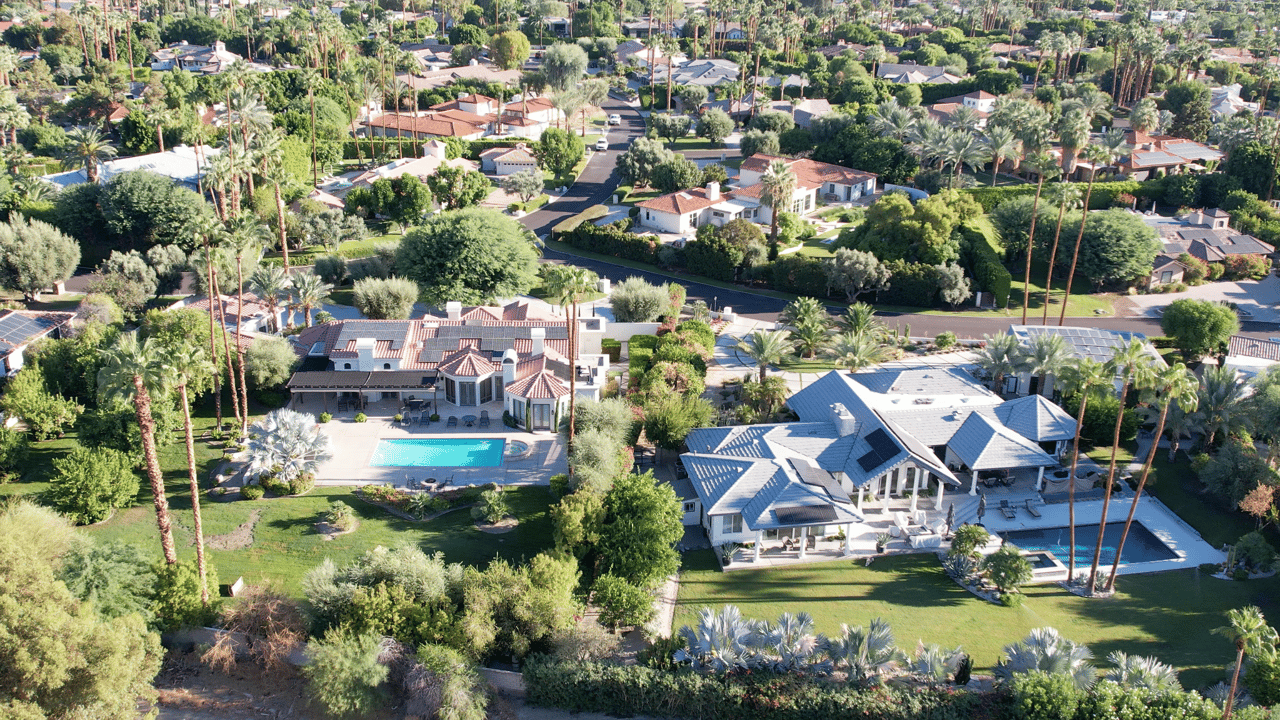
Country-club living can combine residential assessments with separate membership choices. Photo by Bob Osias on Unsplash; photographed at Mission Hills North in Rancho Mirage.
Those three words can change the entire budget.
A charge can be required because it is tied to ownership in the association. A benefit can be included because the association assessment already funds it. A club upgrade can be optional and still add a substantial amount if you choose it.
Mission Hills Country Club illustrates why buyers should not guess. The club currently advertises multiple membership categories, including Premier Golf, Signature Golf, Weekender Golf, Sports Club, and Club Social. Its public membership page tells prospective members to inquire for current initiation fees and monthly dues rather than publishing one universal price.
That means the club website can help you understand the categories, but it does not replace a current written membership proposal for the exact access you want. It also does not tell you by itself what a particular home’s HOA requires.
Before you budget, get clear answers to these questions:
If golf-cart access is part of the lifestyle you want, the guide to golf cart-friendly communities in Rancho Mirage is another useful comparison point.
A lower HOA assessment is not automatically a better value, and a higher assessment is not automatically expensive for what it provides. The important question is what you would pay for the same services outside the association.
Depending on the property, an HOA may cover some combination of:
Do not assume that list applies to every Rancho Mirage HOA. Read the actual budget, CC&Rs, maintenance responsibilities, insurance information, and current fee schedule for the property you are considering.
The same logic applies when comparing community types. A buyer considering a private club, a gated non-golf community, and a non-HOA neighborhood is comparing three different ownership models, not simply three monthly dues. The Rancho Mirage neighborhood guide helps put those settings in context.
Planning a move or comparing Rancho Mirage communities? Start with the FREE Palm Springs Area Relocation Guide, then browse current Rancho Mirage homes for sale to compare properties and community types.
Monthly dues get most of the attention because they are easy to put into a budget. Some of the largest surprises are charges that do not appear as one clean monthly line.
Depending on the community or club, ask about:
Not every community has every charge. That is exactly why an old fee sheet, an online estimate, or a listing-agent comment should be treated as a starting point instead of the final budget.
California disclosure law gives buyers more than a current monthly number. Civil Code Section 4525 requires a seller in a common-interest development to provide governing documents and the most recent annual reports, along with a current statement of regular and special assessments and fees. The disclosure also includes board-approved changes to current assessments and fees that have not yet become due.
If requested by the prospective buyer, Section 4525 also provides for approved board-meeting minutes from the previous 12 months, excluding executive-session meetings. Those minutes can help you understand projects, budget pressure, insurance issues, and topics that may not be obvious from the monthly assessment alone.
Section 5300 requires the association’s annual budget report to include an operating budget, a reserve summary, a reserve-funding plan, information about deferred major repairs, anticipated special assessments for major components, longer-term loans, and a summary of association insurance.
The practical takeaway is simple: do not evaluate an HOA by the dues alone. Review whether the current assessment appears to support the services and long-term obligations the association is responsible for.
Landscaping and shared services are part of the value equation only when you know who maintains them and how they are funded. Photo by Bob Osias on Unsplash; photographed in Rancho Mirage.
When two homes use different fee structures, put them on the same worksheet before comparing them.
For each property, write down:
Then multiply recurring monthly charges by 12 and compare the annual totals. Keep one-time charges on a separate line. That gives you a cleaner picture of the first-year cost and the ongoing annual cost instead of blending everything into one monthly guess.
Some Rancho Mirage properties may involve leasehold land. A ground-lease payment does not replace an HOA or club charge. It is another obligation with its own term, adjustment schedule, transfer rules, financing considerations, and recorded documents.
If you are considering a leasehold property, review the Palm Springs area lease-land versus fee-simple guide and then evaluate the actual lease for that home. The complete monthly cost may include a ground lease, HOA dues, club charges, and normal homeownership expenses at the same time.
A good cost review should leave very little to assumption. Before your contractual deadlines expire, work through the property-specific documents and get clear answers to questions such as:
The best way to compare Rancho Mirage HOA fees is not to chase the lowest number. It is to understand the full cost structure attached to each property.
One home may have a larger association assessment but include services you would otherwise pay for separately. Another may have a modest HOA and a separate private-club structure. A third may have no HOA but require you to handle more maintenance on your own. None of those models is automatically better.
The goal is to know what is mandatory, what is optional, what is included, what can change, and what you will actually use. Once those pieces are separated, Rancho Mirage country club costs become much easier to compare property by property.
For a broader city overview, see the Rancho Mirage community guide.
There is no single Rancho Mirage HOA fee. Some homes have no HOA, while others may have one or more association assessments plus separate club or membership charges. The current amount for a specific property should be confirmed through the HOA disclosure package and current association statement.
Sometimes, but not always. The Springs is an example where the 2025–26 HOA structure includes a social-club assessment, while golf-membership dues are separate. Other communities may use a different structure, so buyers should verify what is included, required, and optional for the exact property.
Association assessments can change. California transfer disclosures include current regular and special assessments and board-approved changes that have not yet become due. Buyers should also review the current budget, reserve information, recent board materials when available, and any known special assessments.
They can be charges from different entities for different purposes. An HOA replenishment or capital charge relates to the association’s structure, while a club initiation fee relates to joining a private club or membership category. The terminology and obligation can vary, so the current written documents should control.
Yes. The monthly assessment tells you what owners are paying now. The budget, reserve information, planned projects, loans, insurance, and potential special assessments help show whether the association has larger financial obligations that deserve attention.
No. A ground lease is a separate land-ownership obligation. A leasehold home can still have HOA assessments and club charges, so all of those costs should be reviewed together.
Tommy Jordan is a California real estate agent (CA DRE #01887038) and leads The Tommy Jordan Group at eXp Realty (CA DRE #02187306). He helps buyers and sellers throughout Rancho Mirage, La Quinta, Palm Desert, Indian Wells, Palm Springs, and the greater Coachella Valley, with practical guidance on local communities, ownership structures, and desert real estate. Learn more about Tommy Jordan or watch the Tommy Jordan | Palm Springs Area Living YouTube channel.

If you are comparing Rancho Mirage homes, The Tommy Jordan Group can help you sort through community structure, HOA obligations, club membership questions, land ownership, and the property-specific details that matter before you buy.
Moving to or within the desert? Get the FREE Palm Springs Area Relocation Guide.
Call or Text: (760) 469-9182
Email: [email protected]
Office: 74801 Hovley Ln E., Palm Desert, CA 92260
Palm Springs
How summer heat, winter seasonality, home maintenance, carrying costs, community rhythm, and California residency questions change when the desert is your primary home… Read more

Construction is underway near Highway 111, but sales have not opened yet. Here is what Shea Homes has published so far about pricing, home sizes, architecture, ameniti… Read more

Palm Springs
What buyers should know about everyday driving, I-10 vs. Highway 111, seasonal congestion, event traffic, weather closures, transit, and testing real routes before cho… Read more
With ten years of experience as a licensed agent, Tommy is an innovator in utilizing social media marketing to help sell homes. He has a successful YouTube channel with thousands of subscribers, generating hundreds of thousands of views yearly. He stays updated on the latest marketing techniques and ensures each property stands out.
Contact Tommy to Learn More

74801 Hovley Ln E. Palm Desert, CA 92260 Tommy Jordan | CA DRE# 01887038

